
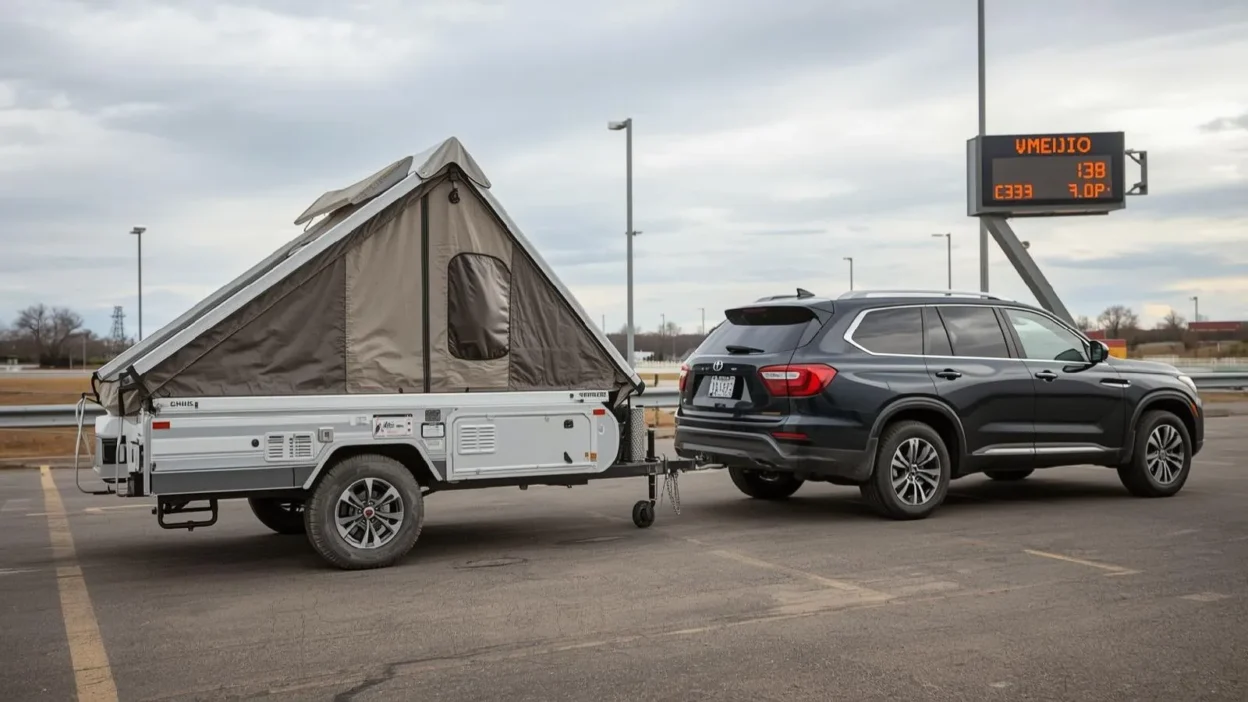
Pop-up campers are often advertised as lightweight and easy to tow but how much does a pop up camper actually weigh? The answer isn’t as simple as many first-time buyers expect. Pop up camper weight can vary widely depending on size, features, and how the camper is loaded, and misunderstanding those numbers can lead to unsafe towing, poor handling, and even vehicle damage.
Whether you’re planning to tow with an SUV, crossover, or small truck, knowing the real towing weight of a pop-up camper is essential. Terms like dry weight, GVWR, and tongue weight are frequently misunderstood, yet they play a major role in determining whether your vehicle can safely handle a camper. Add passengers, water, propane, and gear, and a camper that looks “lightweight” on paper can quickly exceed safe limits.
In this guide, we’ll break down average pop up camper weights, explain key weight ratings, and show you how to calculate your true towing capacity so you can camp with confidence and peace of mind.
What Is the Average Pop-Up Camper Weight?
The average pop up camper weight typically falls between 800 and 3,000 pounds, but the exact number depends on the camper’s size, construction, and features. While pop-up campers are lighter than most travel trailers, weight can vary more than many buyers expect.
Small pop-up campers are the lightest option, often weighing 800 to 1,500 pounds dry. These models usually have shorter box lengths, minimal appliances, and limited storage, making them ideal for compact SUVs and some crossover vehicles.
Mid-size pop-up campers generally weigh between 1,500 and 2,500 pounds. They offer more sleeping capacity, additional storage, and common features like a furnace, refrigerator, or slide-out dinette. This is the most popular category for families.
High-wall pop-up campers are the heaviest, with dry weights ranging from 2,500 to 4,000 pounds. These models feature hard-sided walls, residential-style countertops, taller interiors, and larger appliances. While they provide more comfort, they require a more capable tow vehicle.
It’s important to note that these figures usually represent dry weight only. Once you add water, propane, batteries, food, and camping gear, the fully loaded weight can increase by 500 to 1,000 pounds or more. For safe towing, always plan around the camper’s GVWR, not just the advertised weight.
Understanding Pop-Up Camper Weight Terminology
Before deciding whether your vehicle can safely tow a pop-up camper, it’s essential to understand the weight terms used by manufacturers. These numbers are often misunderstood and can lead to costly towing mistakes.
Dry weight, sometimes called UVW (Unloaded Vehicle Weight), refers to the camper’s weight as it leaves the factory. This number does not include water, propane, batteries, dealer-installed options, or personal gear. While dry weight is commonly advertised, it’s rarely the weight you’ll tow in real-world conditions.
Wet weight includes fluids such as fresh water, propane, and batteries. Because water weighs about 8.3 pounds per gallon, even a small freshwater tank can add significant weight quickly.
The most important number to know is the Gross Vehicle Weight Rating (GVWR). GVWR is the maximum safe weight of the pop-up camper when fully loaded. This includes all gear, fluids, and accessories. Exceeding GVWR can strain the camper’s frame, suspension, and brakes.
Cargo Carrying Capacity (CCC) is the difference between the camper’s dry weight and its GVWR. This tells you how much weight you can safely add.
Finally, tongue weight is the downward force the camper places on the hitch, usually 10–15% of the total trailer weight. Tongue weight counts against your vehicle’s payload capacity and is a common limiting factor for SUVs.
What Factors Affect Pop-Up Camper Weight?
Several factors influence how much a pop-up camper weighs, and understanding them helps explain why two campers of similar size can have very different towing requirements.
Camper size and floor plan play a major role. Longer box lengths, additional sleeping areas, and slide-outs all add weight. Models designed to sleep more people typically include extra structure and storage, increasing overall mass.
Construction materials also make a difference. Campers with steel frames are heavier but more durable, while aluminum frames reduce weight but may cost more. Roof and flooring materials, such as laminated panels or reinforced fiberglass, further affect total weight.
Factory-installed features significantly increase weight. Air conditioners, furnaces, refrigerators, and built-in bathrooms add convenience but also add hundreds of pounds. High-wall pop-up campers, which feature hard-sided walls and residential-style cabinetry, are notably heavier than traditional tent-style models.
Fluids and power components are another major factor. Freshwater tanks, propane cylinders, and batteries all add weight quickly. For example, a 20-gallon freshwater tank alone can add over 160 pounds when full.
Finally, aftermarket upgrades can push a camper close to its weight limit. Solar panels, bike racks, cargo boxes, upgraded mattresses, and additional batteries improve comfort and off-grid capability but reduce available cargo capacity.
Because these factors combine quickly, a camper’s real-world weight is often much higher than its advertised dry weight, making careful planning essential for safe towing.
Pop-Up Camper Weight vs Tow Vehicle Capacity
Matching your pop-up camper’s weight to your tow vehicle’s capacity is critical for safe and stress-free towing. Many drivers focus only on the vehicle’s maximum towing capacity, but that number tells only part of the story.
Your vehicle’s tow rating is the maximum weight it can pull under ideal conditions, typically with a lightly loaded vehicle and a single driver. Real-world towing often falls well below this limit once passengers, cargo, and accessories are added.
Payload capacity is frequently the limiting factor when towing a pop-up camper. Payload includes everything added to the vehiclepassengers, luggage, and the camper’s tongue weight. Even a lightweight pop-up camper can exceed payload limits once tongue weight is applied, especially in SUVs and crossovers.
Different vehicle types handle pop-up campers differently. Compact SUVs and crossovers can tow small, lightweight pop-up campers, but usually with limited cargo capacity. Midsize SUVs and pickup trucks offer more flexibility and can handle mid-size pop-up campers comfortably. Full-size SUVs and trucks are best suited for high-wall pop-up campers and fully loaded setups.
It’s also important to consider braking and stability. Some pop-up campers require trailer brakes, especially as weight increases. Exceeding vehicle limits can lead to poor handling, longer stopping distances, and increased wear on brakes and transmissions.
For safety, many experts recommend staying 10–20% below your vehicle’s maximum ratings rather than towing at the limit.
How to Calculate Your Real-World Pop-Up Camper Towing Weight
To tow safely, you need to know your real-world pop-up camper weight, not just the number listed in the brochure. Calculating this accurately helps prevent exceeding your vehicle’s limits.
Start with the camper’s dry weight, then add the weight of all fluids. Freshwater weighs about 8.3 pounds per gallon, so a 20-gallon tank adds roughly 166 pounds. Include the weight of propane tanks, batteries, and any factory-installed options not included in the base weight.
Next, factor in cargo and gear. Food, cookware, bedding, chairs, tools, and outdoor equipment can easily add 300 to 600 pounds or more. Don’t forget aftermarket accessories such as bike racks, cargo boxes, or solar panels.
Then calculate tongue weight, which is typically 10–15% of the camper’s total loaded weight. Tongue weight is carried by the tow vehicle and counts directly against your payload capacity.
Finally, account for everything inside your vehicle. Passenger weight, pets, coolers, and luggage all reduce the available capacity for towing.
For the most accurate results, visit a CAT scale. Weigh your vehicle alone, then weigh it again with the camper attached and fully loaded. This gives you real, measurable numbers and removes guesswork.
By using actual weights instead of estimates, you can ensure your pop-up camper setup stays within safe limits and performs predictably on the road.
How Heavy Is a Pop-Up Camper When Fully Loaded?
One of the biggest mistakes new owners make is assuming a pop-up camper will weigh close to its advertised dry weight. In reality, a fully loaded pop-up camper often weighs 500 to 1,000 pounds more than its dry weight, and sometimes even more depending on how it’s equipped.
Water is one of the heaviest contributors. Even partially filled freshwater tanks add significant weight, and many campers travel with water onboard for convenience. Propane tanks, batteries, and spare tires further increase total weight before any personal gear is added.
Camping supplies also add up quickly. Food, cookware, bedding, outdoor chairs, grills, tools, and hoses may not seem heavy individually, but together they can push a camper close to its GVWR. Families often carry more gear, which further increases the load.
High-wall pop-up campers tend to see the largest weight increases when fully loaded. Their residential-style appliances, solid walls, and larger storage areas encourage heavier packing, which can reduce safety margins if not carefully managed.
Because of this, it’s important to plan for the worst-case loaded weight, not the best-case scenario. Towing a camper that is too close to its maximum limits leaves little room for error and can negatively affect braking, stability, and handling.
For safer towing, many experienced campers recommend loading conservatively and weighing the camper periodically to ensure it remains within safe operating limits.
Safety Risks of Exceeding Pop-Up Camper Weight Limits
Exceeding pop-up camper weight limits can create serious safety issues, even if the camper feels manageable at low speeds. Towing beyond recommended limits places additional strain on both the camper and the tow vehicle.
One of the most common problems is reduced braking performance. Extra weight increases stopping distances, especially during emergency braking or downhill driving. This risk is even greater if the camper is not equipped with trailer brakes or if the tow vehicle’s brakes are undersized.
Handling and stability are also affected. Overloaded campers are more prone to trailer sway, poor steering response, and difficulty maintaining control in crosswinds or when passing large vehicles. Sudden maneuvers can become unpredictable and dangerous.
Excessive weight also leads to mechanical wear and damage. Transmissions, suspension components, wheel bearings, and tires experience increased stress when towing beyond their design limits. Over time, this can result in costly repairs or premature failure.
There are also legal and insurance considerations. If you’re involved in an accident while towing an overloaded camper, insurance claims may be denied, and liability issues can arise if it’s determined the vehicle was operated outside of manufacturer specifications.
Because of these risks, staying within GVWR, tongue weight, and payload limits is essential. Choosing a lighter camper or reducing cargo weight can significantly improve safety, performance, and peace of mind while towing.
How to Weigh Your Pop-Up Camper Accurately
The only way to truly know your pop-up camper’s weight is to measure it, not estimate. Weighing your setup removes guesswork and ensures you stay within safe towing limits.
One of the easiest and most reliable options is a CAT scale, commonly found at truck stops. These scales are affordable, widely available, and accurate. Start by weighing your tow vehicle alone, fully loaded with passengers and gear. Next, weigh the vehicle and camper together while hitched. The difference between these two numbers reveals the actual trailer weight.
To measure tongue weight, you can use a specialized tongue weight scale or visit a scale that allows separate axle measurements. Tongue weight is especially important for SUVs, as it counts directly against payload capacity.
It’s best to weigh your camper in real camping condition. Fill water tanks as you normally would, load all gear, and install any accessories before weighing. This provides a realistic picture of your true towing weight.
Weighing shouldn’t be a one-time task. Recheck weights after major changes, such as adding solar panels, upgrading batteries, or changing packing habits. Even small modifications can significantly affect total weight.
By knowing your exact numbers, you can tow with confidence, reduce wear on your vehicle, and avoid safety issues caused by unknowingly exceeding weight limits.
Lightweight vs High-Wall Pop-Up Campers
Pop-up campers generally fall into two categories: lightweight traditional pop-ups and high-wall pop-up campers. While both offer unique advantages, their weight differences can significantly impact towing requirements.
Lightweight pop-up campers typically weigh between 800 and 2,000 pounds dry. They use soft-sided canvas walls, lower profiles, and minimal cabinetry to keep weight down. These models are ideal for compact SUVs, crossovers, and drivers who want easier towing, better fuel economy, and simpler setup. However, they often sacrifice interior height, storage, and luxury features.
High-wall pop-up campers, on the other hand, feature solid walls, taller interiors, and residential-style countertops and appliances. While they offer a more travel-trailer-like experience, they are considerably heavier, with dry weights often exceeding 2,500 pounds and much higher loaded weights. These campers usually require midsize or full-size SUVs and trucks with higher payload and towing capacities.
The choice comes down to comfort versus towing simplicity. If your vehicle is near its towing limits, a lightweight pop-up camper provides a safer margin and less stress on your drivetrain. If you have a capable tow vehicle and prioritize interior space and amenities, a high-wall model may be worth the added weight.
Understanding these differences helps ensure you choose a camper that matches both your camping style and your vehicle’s capabilities.
Can You Reduce Pop-Up Camper Weight?
Yes, in many cases you can reduce pop-up camper weight with smarter packing and equipment choices. Even small weight reductions can improve towing safety and vehicle performance.
Start with strategic packing. Bring only what you use regularly and avoid duplicating items. Lightweight cookware, collapsible containers, and multi-purpose gear can significantly cut down on unnecessary weight. Store heavier items low and close to the axle to help maintain proper balance.
Managing water weight is another effective strategy. Traveling with empty or partially filled freshwater tanks can save hundreds of pounds, especially if you camp at sites with water hookups. Fill tanks closer to your destination when possible.
Upgrading equipment can also help. Switching from traditional lead-acid batteries to lithium batteries reduces weight while increasing usable power. Lightweight propane tanks and compact solar panels can further improve efficiency without adding excessive mass.
However, it’s important not to remove or modify critical safety components. Brakes, stabilizers, tires, and structural elements should never be compromised to save weight. Doing so can create serious safety risks.
Finally, regularly review your setup. Over time, campers tend to accumulate extra gear that’s rarely used. Periodically unloading and reassessing what you carry helps keep your pop-up camper within safe weight limits while still maintaining comfort and convenience on the road.
Pop-Up Camper Weight FAQs
How much does a pop-up camper weigh on average?
Most pop-up campers weigh between 800 and 3,000 pounds dry, depending on size and features. Fully loaded models often weigh 500 to 1,000 pounds more than their advertised dry weight.
Can a small SUV tow a pop-up camper?
Yes, many small and midsize SUVs can tow lightweight pop-up campers. However, you must consider payload capacity and tongue weight, not just the vehicle’s towing rating.
Is tongue weight included in towing capacity?
No. Tongue weight counts against your vehicle’s payload capacity, not its towing capacity. This is a common source of confusion for new owners.
Do pop-up campers need trailer brakes?
Some pop-up campers do, especially heavier or high-wall models. Many states require trailer brakes above certain weight thresholds, and they greatly improve safety.
Are pop-up campers lighter than travel trailers?
Yes. Pop-up campers are generally much lighter than traditional travel trailers, making them easier to tow and more fuel-efficient.
How much does water add to pop-up camper weight?
Water weighs about 8.3 pounds per gallon. A 20-gallon tank adds over 160 pounds when full.
What is the safest way to choose a pop-up camper weight?
Choose a camper with a GVWR well below your vehicle’s maximum limits to allow a safety margin for gear, passengers, and future upgrades.
Conclusion: Choosing the Right Pop-Up Camper Weight for Safe Towing
Understanding pop up camper weight is one of the most important steps in choosing the right camper and towing it safely. While pop-up campers are often marketed as lightweight, their real-world weight can be much higher once water, propane, batteries, gear, and passengers are included. Relying only on dry weight numbers can lead to unsafe towing conditions and unnecessary stress on your vehicle.
The key is to focus on GVWR, payload capacity, and tongue weight, not just maximum towing ratings. Taking the time to calculate your fully loaded setup and verifying it on a scale provides clarity and confidence before hitting the road. Choosing a camper that leaves a comfortable safety margin rather than towing at the limit results in better handling, improved braking, and a more relaxed driving experience.
It’s also important to be realistic about how you camp. Families, longer trips, and high-wall pop-up campers naturally add more weight, making careful planning even more critical. Regularly reviewing your gear and weighing your camper after major changes helps prevent surprises.
By understanding weight terminology, knowing your vehicle’s limits, and planning conservatively, you can enjoy the convenience and flexibility of a pop-up camper without compromising safety. A properly matched camper and tow vehicle make every trip smoother, safer, and far more enjoyable.

Silva is a passionate writer and thinker dedicated to capturing the essence of life through inspiring quotes and reflections. With a keen eye for words that motivate, uplift, and spark meaningful thought, Silva shares insights that resonate deeply with readers seeking positivity, wisdom, and self-growth. At quoteblom.com, Silva’s work brings a blend of creativity and authenticity, making every quote a moment of inspiration.